
Despite its use by the GenoLIE promoters, “genocide” is not a synonym for mass killing, or for a war with heavy civilian losses. It is a specific crime with a specific legal definition, and the gap between its popular use and what it requires in a courtroom is massive. Even the United Nations concedes that the popular use and understanding of the term – which has been significantly distorted from the legal definition – is far broader than international law allows.[i]
The crime of genocide was defined in the 1948 Genocide Convention, drafted following the Holocaust. Under Article II, genocide means certain acts – killing, causing serious harm, inflicting destructive conditions of life – committed “with intent to destroy, in whole or in part, a national, ethnical, racial or religious group, as such.”[ii]
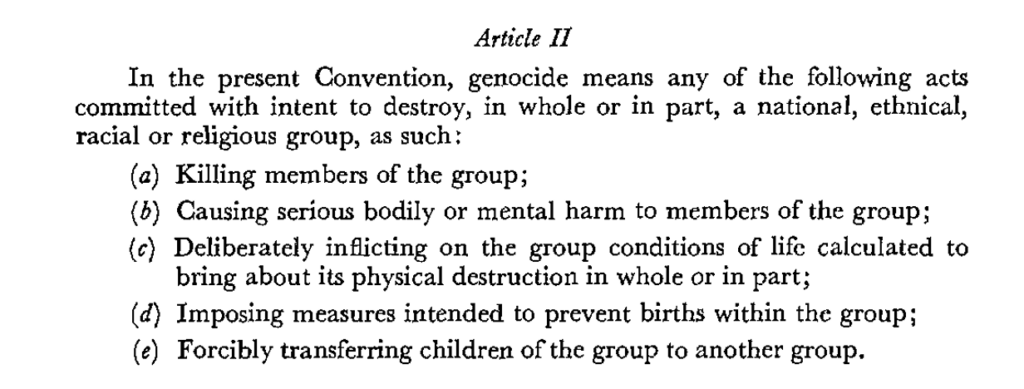
The most crucial element of that definition is the word “intent.” The law does not ask merely whether people died, or whether they died in large numbers. It asks whether the perpetrator acted with the specific purpose of destroying a protected group because of its membership in that group. The UN’s own guidance calls intent “the most difficult element to determine” and stresses that neither the dispersal of a group nor its cultural erasure meets the bar.[iii] During the Convention’s drafting, delegates were explicit that heavy civilian losses during war do not – as a rule – constitute genocide.[iv]
International courts have applied this standard consistently and rigorously.
In the 2007 case Bosnia v. Serbia, the International Court of Justice (ICJ) confirmed that genocide had occurred at Srebrenica – some 8,000 men and boys murdered – yet declined to hold Serbia responsible for committing it, finding only that it failed to prevent the genocide and punish the perpetrators.[v]
In the 2015 case Croatia v. Serbia, the ICJ dismissed genocide claims from both sides, ruling that neither had proven specific intent.[vi] The standard established by the court in that case to infer genocidal intent from a pattern of conduct is that intent must be “the only inference that could reasonably be drawn.”[vii] Put simply, if any other reasonable explanation for the conduct exists, the charge of genocide fails as a matter of law.
In the case of Gaza – where the legal term of genocide has been widely distorted – the case for genocide collapses under its own standard, as a competing and entirely reasonable inference is available and abundantly documented:
- Israel waged war following the Hamas attacks on its civilians, to dismantle Hamas and secure the release of the hostages.
- The civilian death toll was a consequence of urban combat against an enemy that purposely and cynically embeds itself among its own population.
- Because a lawful war objective following a massacre of its civilians is a reasonable explanation for Israel’s conduct, genocidal intent cannot be the only reasonable inference. Therefore, under the ICJ’s own test, the genocide argument fails.
- Moreover, throughout the war in Gaza, Israel went to extraordinary lengths to minimize civilian casualties, including by sending out numerous warnings before each strike and following strict rules of engagement, even when doing so put its own civilians and soldiers at risk. None of these actions are consistent with genocidal intent.
Gaza GenoLIE proponents often claim that the ICJ has already validated the genocide charge, which is yet another lie. In January 2024, the Court found that some of the rights South Africa sought to protect were “plausible” and ordered provisional measures.[viii] But that plausibility finding concerns the rights of Palestinians as a protected group – not a finding that genocide is being committed.[ix] ICJ judges even emphasized the gap between the low threshold at that preliminary stage and the much more stringent test required to find genocidal intent.[x] International law must be taken seriously, not distorted and embellished to spread false claims of genocide to demonize the only Jewish state and its people, who genuinely know all too well about the most serious crime of all international crimes.
The “Gaza Genocide” is one of the biggest lies of the 21st century. It was generated and promoted by anti-Zionist and antisemitic networks following the October 7 Massacre to prevent Israel from saving its hostages, delegitimize the Jewish state, and fuel global antisemitism.
Read the next piece to learn more on the Gaza GenoLIE puzzle.
[i]“Definitions of Genocide and Related Crimes,” United Nations. https://www.un.org/en/genocide-prevention/definition
[ii]Ibid, citing Convention on the Prevention and Punishment of the Crime of Genocide, Art. II, 1948.
[iii]Ibid.
[iv]Goda, “The Genocide Libel,” ISCA 2025-3, citing the Convention’s Travaux Préparatoires. https://isca.indiana.edu/publication-research/research-paper-series/norman-jw-goda-research-paper.html
[v]Application of the Genocide Convention (Bosnia v. Serbia), ICJ Judgment, Feb. 26, 2007. https://www.icj-cij.org/node/101888
[vi]Croatia v. Serbia, ICJ Judgment, Feb. 3, 2015; Summary of the Judgment. https://www.icj-cij.org/case/118
[vii]Ibid.
[viii]South Africa v. Israel, ICJ Order on Provisional Measures, January 26, 2024. https://www.icj-cij.org/node/203447
[ix]On the “plausibility of rights” distinction, “Implausible Confusion: The Meaning of ‘Plausibility,’” EJIL: Talk! https://www.ejiltalk.org/implausible-confusion-the-meaning-of-plausibility-in-the-icjs-provisional-measures/
[x]Declaration of Judge Nolte, appended to the January 26, 2024 Order. https://www.icj-cij.org/node/203447